The World in Motion: Living in a Landscape of Probabilities

We are often taught, almost from childhood, to see the world as a fixed and stable place — a world made of concrete objects, solid institutions, enduring relationships, and tidy categories. You go left, or you go right. You succeed, or you fail. You’re accepted, or rejected. It’s a worldview that gives the comfort of clarity: choices have clear consequences, outcomes feel earned, and control seems within reach if only we are diligent enough. Yet underneath this neat surface hums something far more elusive, far more unsettling — a world in motion, governed not by certainties, but by probabilities. A world where every moment unfolds across a branching field of possible futures, none guaranteed, all alive with risk and potential.
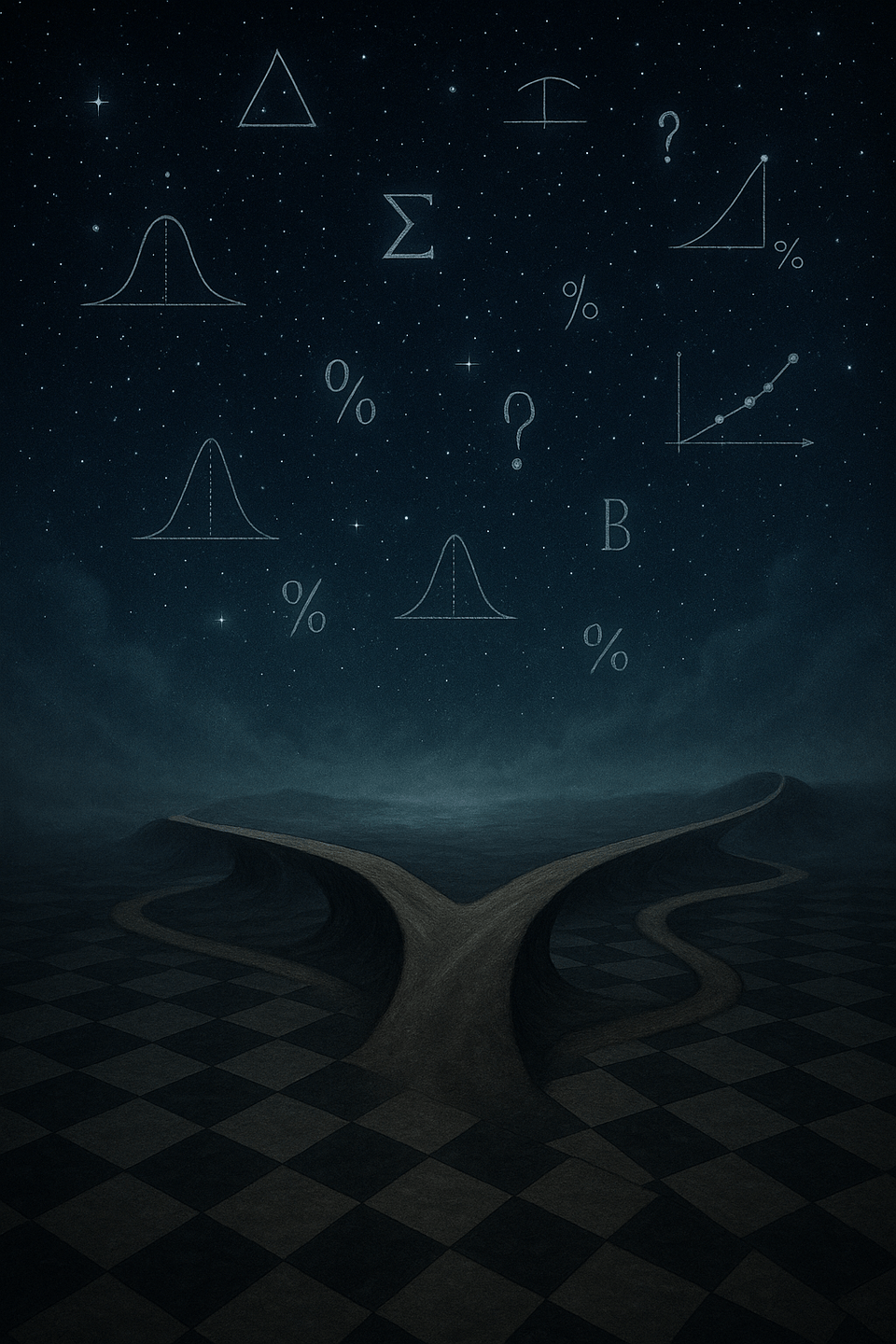
In this dynamic landscape, every action ripples outward through layers of possibility, touching off consequences we can scarcely predict. Taking a left turn instead of a right may seem trivial — just a minor choice in the machinery of a day — yet it can send your life, and the lives of those around you, onto an entirely different trajectory. A chance encounter, a conversation overheard, an opportunity glimpsed or lost — each seemingly small moment contains within it the seeds of transformation. And when you begin to see the world this way, the ground beneath your feet subtly shifts. Life stops being a simple chain of causes and effects and becomes something more like an ever-branching tree, where every step forward carries within it a spread of possible outcomes, each weighted with its own statistical likelihood.
To live with this awareness is to abandon, piece by piece, the illusion of control. You begin to understand that no decision, however carefully considered, can ensure the outcome you desire. You see that success is not purely the fruit of merit, nor failure purely the result of personal deficiency. You come to recognize that you are not steering some perfectly engineered machine, but rather surfing on the crest of a wave, riding a current whose full shape you cannot predict. And this realization, while humbling, also holds a quiet kind of grace: it softens the harshness with which we so often judge ourselves and others, and invites a deeper sense of humility before the forces that shape our lives.
This shift in perspective has profound consequences — some illuminating, others deeply alienating.
First, it reshapes how we understand the present. When you begin to perceive the probabilistic undercurrents of reality, you start to see the fragility of the systems we depend on. Markets, governments, social orders — these are not immovable architectures, but delicate balancing acts, kept stable only by a narrow band of conditions. What appears as “order” is often just the temporary alignment of countless variables, any one of which might tip the balance into chaos. Stability, you realize, is not the natural state of things, but a fleeting and fragile achievement — a phase, not a guarantee. And with this realization comes a new sensitivity: you begin to notice the cracks in the façade, the quiet tremors beneath the surface, the ways in which complexity both sustains and imperils the world we have built.
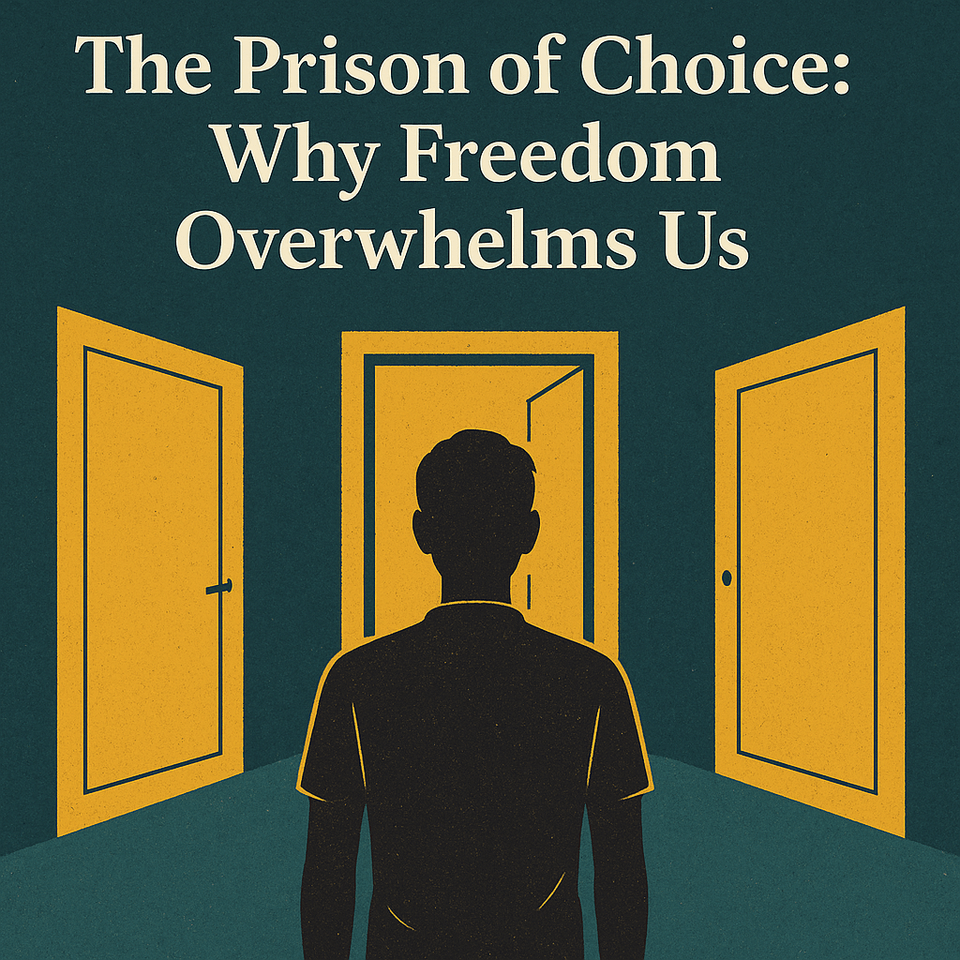
Second, this worldview transforms how we imagine the future. Instead of seeing a single inevitable path stretching forward, you begin to glimpse a labyrinth of possibilities, a shimmering network of potential worlds, each branching from the smallest of choices. This can be exhilarating — it opens the imagination, it fills life with possibility. We are not locked into a predetermined script; we have agency, and with that agency comes the power to shape which futures unfold. But this same realization can also be paralyzing. When every decision carries within it the weight of cascading consequences, when every small action opens up an entire spread of potential futures, how does one act without being crushed by the enormity of what might happen? The freedom of possibility becomes a burden; the imagination of what could go wrong becomes a constant shadow at your side.
Most striking, though, is how this probabilistic orientation reshapes the self in relation to society. When you internalize the idea that the world runs on probabilities, you can’t help but develop a deeper empathy — both for the fragility of individuals and for the vulnerability of the collective systems we inhabit. You begin to see that suffering, injustice, collapse — these are not aberrations or malfunctions in an otherwise smooth-running machine, but inherent possibilities within any complex system. And once you see that, the desire to “save the world” becomes almost inevitable. But here’s where the paradox emerges: the more deeply you grasp the probabilistic nature of the world, the more acutely you recognize the limits of intervention. To believe you can save the world implies a kind of straightforward, linear causality — that with the right actions, you can produce the right outcomes. But probability resists this logic. You may improve the odds, you may reduce harm, you may shape the landscape of possibilities — but you will never escape uncertainty.
For some, this realization is a call to humility. It invites a quieter form of activism, one that works without illusion, one that understands the limits of control but refuses to collapse into despair. For others, it breeds a subtle kind of alienation, a feeling of standing slightly apart from the ordinary flow of human life, burdened with an awareness that can’t easily be shared. You notice the blind spots in the people around you, the small arrogances and illusions of mastery that allow ordinary life to proceed. You see the fragility beneath the routines, the unspoken bets we all place on stability, on permanence, on things continuing as they are. And you know, too well, how delicate it all is.
Living in a probabilistic world means learning to walk a narrow path — between action and surrender, between conviction and doubt, between the moral urgency to repair what is broken and the sober knowledge of how much lies beyond our reach. It means, above all, learning to act without the comfort of certainty — to make your way forward on what the philosopher William James called “a sea of probabilities,” where faith is not in outcomes, but in the meaningfulness of the attempt itself.
And perhaps, in that, there is a quiet form of freedom. Not the freedom of mastery or conquest, but the freedom of participation — of showing up, of acting, of loving and creating, even in the face of uncertainty. To live fully in a world of probabilities is not to seek escape from risk, but to embrace life precisely as it is: fragile, contingent, unfinished, and beautiful in its endless unfolding.