The Distance Between Events

What is time?
The question has followed me for nearly two decades, a shadow that lengthens but never resolves. Physicists have filled libraries with their formulations, philosophers with their meditations, yet the strangeness remains untouched. We measure it, divide it, build our lives around it, but do we know what it is?
In my earlier reflections on antimatter and symmetry, I suggested that perhaps time itself is not as secure as we assume. If antimatter can be described as traveling backwards through it, and matter as forwards, then the very idea of direction is unsettled. Forward compared to what? Backward in relation to whom?
Modern physics, of course, grants time the dignity of a dimension. It writes time into its equations with the same formality as space, differing only by a minus sign. Yet even here the suspicion lingers: is time truly woven into the fabric of reality, or is it only a convenience of our modeling? A scaffolding mistaken for stone?
And so the question returns. Not as an abstraction, not as a puzzle for specialists, but as a weight upon daily existence. Every moment we feel its passing. Every memory weaves its trace. Every anticipation binds us to its horizon. Still, we cannot name what it is.
Is Time a Dimension?
Physics tells us so. It writes time beside space, as though the two were kin. In the line element we are given,
a simple expression that claims to capture the very shape of reality. And yet, how strange that time enters so quietly, so unexamined. Why do we not pause to ask what it means to speak of a “distance” in time?
Is it truly the case that time is another dimension, like length or width or height? Or is it simply that by treating it so, our equations become elegant? Does this elegance reflect nature itself, or only our desire for symmetry?
The minus sign whispers difference, but is it enough? In what sense can we place an instant on the same footing as a location? When I walk across a room, the distance I cover is real—extension exists between one point and another. But when I wait in silence, what exactly stretches between one moment and the next? Is there anything “there” at all, or do we call it “time” because we cannot bear the emptiness between events?
We call it spacetime, as though the two were fused into one cloth. But what if that cloth is only the projection of our minds? What if the unity is a fiction born of mathematical convenience? Would the universe itself look any different if we refused to grant time the status of a dimension?
Perhaps time was never a sibling of space, but only its reflection in a different mirror. Perhaps what we call the “geometry of time” is not geometry at all, but the ordering of change dressed up as distance. But if so, why has physics been so successful in treating it otherwise? Is that success evidence of truth, or only of utility?
And if time is not a dimension, then what is it? A rhythm? A sequence? A distance between changes? Or perhaps nothing at all—only a shadow cast by motion, mistaken for substance.
What Is the Meaning of
The calculus of physics depends upon it. We write
Is it the tick of a universal clock, a grain of the cosmos itself? Or is it only a mathematical trick, a symbol for how we compare one change to another? When I write
In the infinitesimal limit, we imagine slicing reality frame by frame, as though the world could be frozen into still images and then reassembled. But does nature actually contain these frames, or are they only artifacts of the way we calculate? Is
What does it mean to take a derivative with respect to something that might not exist? If time is not a dimension, if it is not a background upon which events play, then what is this infinitesimal increment we invoke with such confidence? Could it be that
And if that is all it is, then is physics not built upon a ghost—an elegant, indispensable, but perhaps imaginary measure of something that never was?
Does Antimatter Travel Backwards?
Some physicists have long entertained the thought: what if an antiparticle is nothing more than a particle moving backwards in time? Feynman sketched it on paper as if it were no more mysterious than a change of sign, a reversal in the axis of a diagram. But if this interpretation holds truth beyond metaphor, what does it mean to speak of such a reversal?
What is “backwards” if time itself is not fundamental? If time is only the measure of distance between changes, then to move backwards through it would mean what—reversing the order of states, unravelling the distance already traversed? Is antimatter truly retracing steps across a dimension, or is it simply tracing a mirror-pattern of change that we mistake for reversal?
And if matter moves “forwards” and antimatter “backwards,” who is to say which direction is the original? Might both be illusions born from our perspective, the symmetry of two currents in a river where “upstream” and “downstream” are words of the observer, not qualities of the water itself?
CPT symmetry promises invariance when we flip charge, flip space, flip time. But if time is not a real dimension, then what are we flipping? Perhaps not time itself, but the order of event-distance, the sequence of changes. Could it be that antimatter does not inhabit a different kind of time, but only lives out the same distances in reverse correlation?
And if so, is the true mystery not that antimatter moves backwards, but that we ever believed “forwards” had meaning at all?
Can We Rebuild Physics Without Time?
What would remain of physics if we stripped away time altogether? Could the edifice still stand without its most familiar pillar, or would the whole structure collapse into silence?
Already there are whispers that it might be possible. The Wheeler–DeWitt equation of quantum gravity presents us with an unsettling clue:
No
Would motion itself still make sense without time? If we no longer had the comfort of “before” and “after,” how would we speak of an object crossing a room, of a star collapsing, of a child growing? Or would all these images collapse into correlations—this position tied to that, this state bound to another—without any invisible thread running through them to mark progression?
Our mathematics seems to depend on time as an axis. The derivative
What would energy become in such a world? What would entropy mean, if no arrow stretched forward? Would probability itself survive without the horizon of the future to lean against? Or are these very ideas—energy, entropy, probability—secretly dependent on the scaffolding of time, unable to stand once it is pulled away?
And then there is the question of perception. If physics without time is possible, can human experience follow it there? We live as though time is the most obvious reality. Our memories stitch past into present, our hopes pull us into futures not yet arrived. Without time, how would consciousness describe itself? Could we imagine a self not defined by the thread of moments, but by the simultaneity of patterns, a presence suspended in correlations rather than carried forward by a flow?
If we dared to erase time from the canvas, would the picture vanish into chaos, or would another order emerge—an order not of rivers but of mosaics, not of flows but of structures? And if such an order exists, have we been looking at it all along, mistaking a still tapestry for a moving story simply because our own minds crave sequence?
Is Time a Distance Between Events?
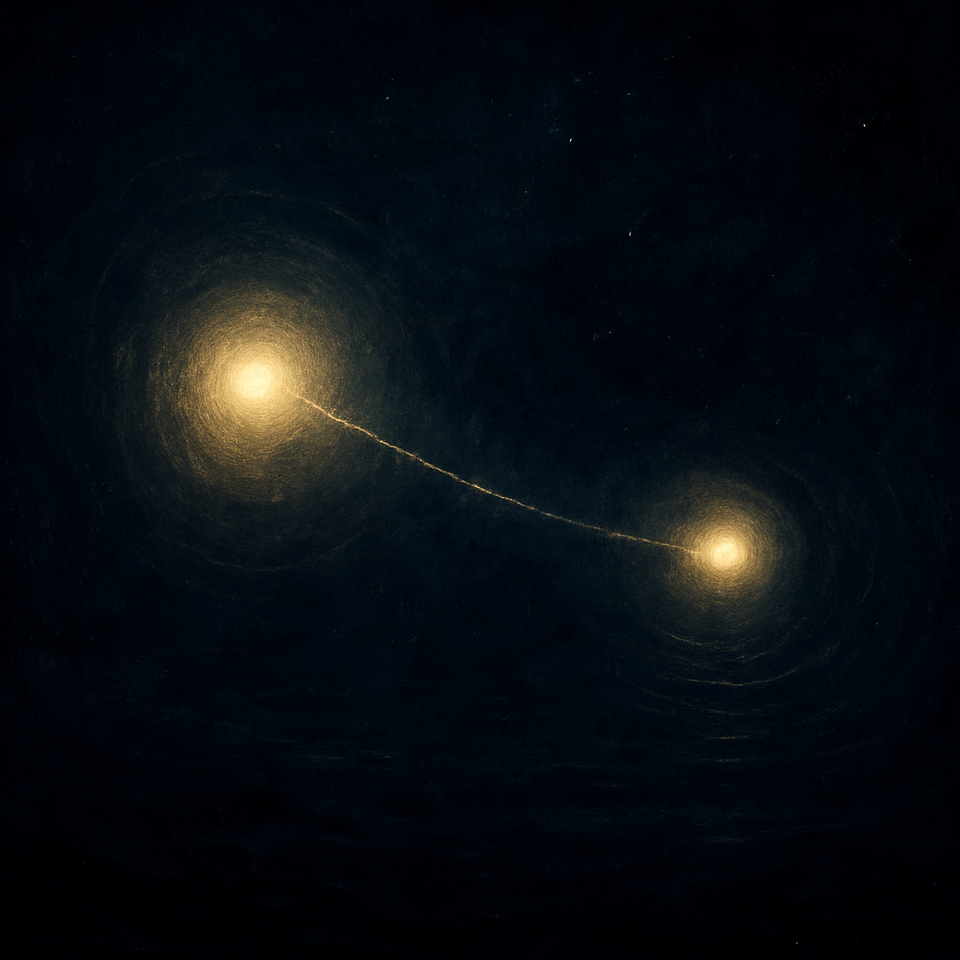
If time is not a dimension, not a flowing river, not even a hidden axis in the equations, then what is left for it to be? Could it be nothing more—and nothing less—than a measure of the distance between events?
When one state gives way to another, when a particle decays, when a leaf falls, when a thought arises—something separates these happenings. Is that separation what we call time? Is time not an entity in itself, but the very spacing between change and change, the invisible thread that marks difference?
But what kind of “distance” is this? When we measure the stretch of a road, there is something extended between its ends. But when we measure the stretch between events, what lies between them? Is it a real interval, or simply our way of naming the fact that they are not simultaneous? Is time nothing but the recognition of “not at once”?
Consider two moments of stillness: a pendulum at rest, a heart between beats, the silence that lingers before speech. Does time pass there at all, or does it only come into being once something shifts, once a state is no longer what it was? Could it be that what we name “the passage of time” is nothing other than the recognition of change, dressed in the language of continuity?
And what of memory? Is the sense of time’s passing nothing more than the accumulation of remembered changes, a layering of difference upon difference? Without memory, would the distance between events collapse, leaving us suspended in a present without depth? Or is memory itself the very act of measuring time, the creation of distance where otherwise there would only be immediacy?
If so, then time is not something that flows around us, but something that arises within the fabric of events themselves. Not a background, but a measure. Not a substance, but a distance. But if that is so, why does it feel so real to us? Why do we live as though it carries us forward, rather than as though we ourselves mark its measure?
And if time is only distance between events, what happens to the idea of eternity? Does an infinite stretch of time mean anything if nothing changes within it? Would an unchanging eternity be indistinguishable from no time at all? And if so, could it be that eternity is not endless time, but the absence of time entirely?
What then of the finite? Is a life “long” because of the years it counts, or because of the density of change it contains? Do we measure our days by the clocks on our walls, or by the distances between the events that mattered? And if so, is it possible that time has always been less about what the universe is, and more about what we choose to notice?
What Does Distance in Time Mean?
If time is distance between events, what kind of distance is it? When I measure the span of a road, there is extension laid out between its ends, something that can be walked, counted, occupied. But when I measure the span between moments, what is it that lies between? Is there anything there at all, or is the “between” only a name for absence?
Perhaps distance in space is presence, while distance in time is absence. But absence of what? Of simultaneity, of coincidence, of being at once. Could it be that time is nothing more than the refusal of events to occur together?
And yet we experience it differently. A kilometer on a road and an hour on a clock do not feel the same. Why should one distance weigh heavy on us, while the other simply stretches in extension? Why do we speak of time as “passing,” of hours as “lost” or “gained,” when we do not say the same of length? Does time carry a burden that space does not?
Physics writes time into the line element as though it were simply another coordinate, indistinguishable from space but for a sign. But is that minus sign only a mathematical device, or does it encode something deeper—that distance in time is not extension at all, but causality? That to say two events are separated by time is to say they are bound by the possibility of influence, by an arrow of cause that cannot be reversed?
If so, then distance in time is not the same as distance in space, no matter how elegantly our equations try to make them kin. One measures separation of place, the other separation of change. One is extension, the other order. And if we confuse the two, do we risk mistaking convenience for truth, symmetry for reality?
And yet again, the question lingers: if time is only the measure of this distance, then what gives it its weight, its texture, its flow? Why do some distances in time feel short, while others stretch unbearably long? If two minutes can feel like an eternity and two years can vanish in an instant, what does that say about the nature of this distance we are trying to name?
What Then Becomes of Us?
If time is nothing more than the distance between events, what does that mean for the story of a life? Is a life measured in years, or in the number of changes that marked it, the shifts that carved it into shape? Does one who lived a thousand quiet days live longer or shorter than one who crossed a thousand thresholds of change in the same span?
What does it mean to grow old, if time itself does not flow? Is age not then a measure of distance—distance between the event of birth and the present state of the body? If so, are we not all mosaics of distances, patchworks of change, each stitched together by memory into the illusion of a continuous thread?
And what of death? If time is only distance, does death mean the end of distance, or the end of change? If no new states unfold, if no new events arise, does time itself vanish for the one who no longer moves within it? Could eternity then be nothing more than the absence of further distance, the stillness beyond change?
And memory again insists on its role. Is it not memory that creates the sense of a past, that strings events into a story, that stretches the distance into a line we can follow? Without memory, would we not live in a perpetual present, where change still happens but never accumulates? Would we still speak of time, or only of immediacy?
If so, what then becomes of us? Are we creatures carried by time, or creators of it? Do we move through it, or does it emerge through the way we hold our changes, the way we gather the distances that separate one moment from another?
And if time is only the measure of distance, is it not possible that all along we have mistaken the measure for the thing itself, and that what we truly inhabit is not time, but the unfolding of change, the endless spacing of events that refuses ever to be final?