
Secured Debt, What Is It?

As my frequent readers know, I’m autistic, this means socialising is a struggle for me and not something I endeavour for unless absolutely necessary, it’s been a few years since I last had any sort of meaningful conversation with another human being, outside the pleasantries required by my day job delivering parcels. Though, I’ve recently been getting out of my shell a little more, exchanging words with other people, mostly customers and other drivers at the Amazon Depot, and I had an interesting exchange that inspired me to write this post as it became quickly apparent that there is a lack of understanding in the differences between secured and unsecured debt.
Debt, in its most fundamental sense, is a promise — a contractual obligation to repay what you have borrowed, typically with interest. But not all promises carry the same weight, and not all debt is structured the same way. The distinction that matters most, and the one that most people never think about until it is too late, is whether that debt is secured or unsecured. The difference is not merely technical. It determines what a lender can do if things go wrong, and more importantly, what they can take.
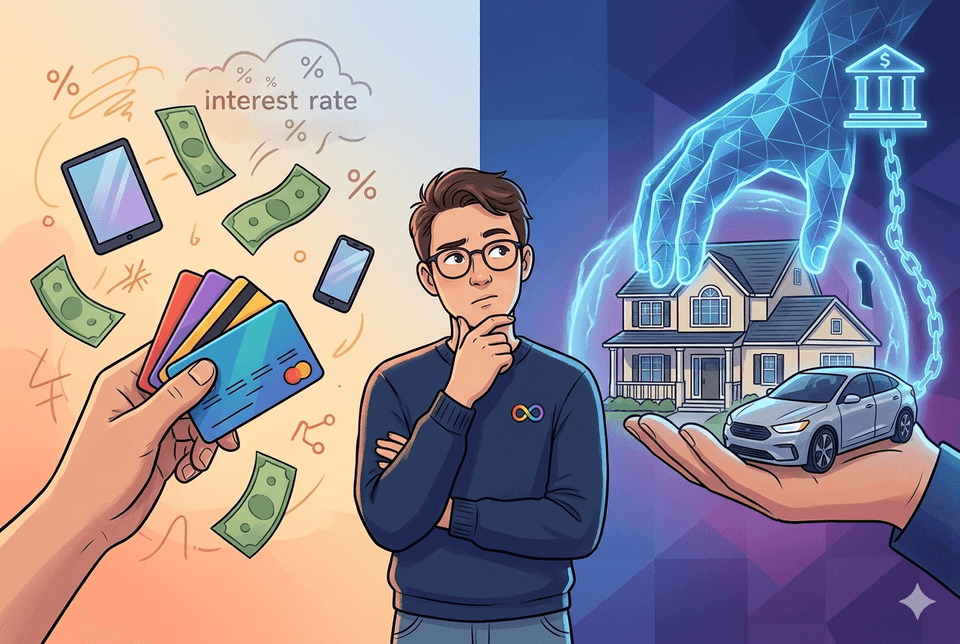
Unsecured debt is the kind most people accumulate without much thought. A credit card balance is the clearest example. When a bank extends you a credit limit, they are lending you money on the basis of your creditworthiness alone — your income, your history, your perceived reliability as a borrower. There is no asset backing the arrangement. If you buy a television on a credit card and then fail to repay the debt, the bank cannot come to your door and reclaim the television. They have no legal claim over any specific thing you own. Their recourse is limited to chasing the debt through collections, damaging your credit score, or in more serious cases pursuing a county court judgement. A personal loan, similarly, is unsecured in most common forms — the bank lends you a lump sum based on your credit profile, and beyond the legal mechanisms available to any creditor, they have no hold over your possessions if you stop paying.
Secured debt works on an entirely different principle. Here, the loan is not merely backed by your word — it is backed by an asset. The asset serves as collateral, which means the lender retains a legal interest in it for the duration of the loan. A mortgage is the most well-known example. When a bank lends you two hundred thousand pounds to purchase a home, they are not simply trusting you to repay them. They hold a charge over the property. The house itself is the security. If you stop making payments, the lender has the legal right to repossess the property, sell it, and recover what they are owed from the proceeds. You do not truly own that house in any full or final sense until the mortgage is discharged. Until then, you are, in a meaningful way, a custodian of an asset that a lender has a prior claim over.
Car finance operates on the same logic. When a finance company funds the purchase of a vehicle, whether through hire purchase or a personal contract purchase agreement, the loan is secured against the car. The finance operator is essentially the legal owner of the vehicle until the final payment is made. This is not a technicality buried in the small print — it has real and immediate consequences. If you fall into arrears, the finance company does not need to pursue you through the courts in the same way an unsecured creditor might. They can repossess the car, because legally, it is still theirs to take. The vehicle is the collateral, and its recoverable market value is precisely what gave them the confidence to extend the loan in the first place.
This is where the practical distinction becomes most stark, and where most people’s understanding tends to collapse. Imagine someone who finds themselves in serious financial difficulty — mounting debts, no savings, and ultimately no choice but to pursue bankruptcy. If that person’s debts consist entirely of credit card balances, personal loans, and overdrafts, then bankruptcy can offer something close to a clean slate. With no assets to liquidate, the unsecured creditors receive nothing, the debts are written off, and the individual, after the statutory period, can begin again. It is a brutal but functional mechanism, and the system is designed to allow it because unsecured lenders priced that risk into the interest rates they charged from the beginning.
But introduce a car on finance into that picture and the situation changes immediately. The vehicle is not an asset that the individual fully owns — not legally, not yet. The finance company holds a prior interest in it, and that interest survives the bankruptcy process. They can repossess the car regardless of the bankruptcy proceedings, because they are not chasing a debt so much as recovering their own property. The distinction is not just legal abstraction. It means that someone who believed they were walking away from everything might find themselves without transport, losing their ability to work, losing the very thing they needed to earn the income they could no longer afford to service. The secured creditor is structurally insulated from the consequences that devastate unsecured creditors.
Understanding this distinction matters because it changes how you should think about the debt you take on. Unsecured debt, for all its convenience, tends to carry higher interest rates precisely because the lender is taking on more risk — they have no fallback, no asset to recover, no floor beneath their exposure. Secured debt typically comes with lower rates because the lender has a guaranteed recovery mechanism. The lower monthly cost of a car on finance, relative to an unsecured personal loan for the same amount, is not a gift. It is a trade. You are accepting a lower rate in exchange for granting the lender a legal claim over something tangible in your life. When times are good, that trade feels invisible. When times are hard, it becomes the only thing that matters.
Most people, when they sign a finance agreement, are thinking about the monthly payment. Very few are thinking about what they are actually agreeing to in the event that those payments stop. And that gap in understanding — between the transaction as it feels and the contract as it is — is precisely where financial difficulty tends to take root.