
The Contract Nobody Signed

Consider the word service. Public service. National service. Civil service. Essential services. The word carries a direction embedded within it — a vector, pointing from the one who serves toward the one being served. A service is not a thing that exists in isolation. It exists in relation. It presupposes a beneficiary. And the beneficiary, in all of these formulations, is the public. The people. The aggregate of ordinary lives whose taxes and compliance and daily labour constitute the substrate on which every institution stands.
Nobody wrote this down. Nobody had to. It was assumed — absorbed into the grammar of public life as quietly as a person absorbs the customs of the house they grew up in. You knew the rules not because you were handed a rulebook but because you were present and paying attention and because the rules were everywhere, implicit in every surface. This is what I mean by the implied social contract. Not a document. Not a treaty. Not the philosophical construct Rousseau erected with such architectural precision. Something older and more instinctive than any of that. The baseline expectation of a human being living inside a society — that the structures which claim to serve them are, in fact, oriented toward their welfare rather than toward their extraction.
It begins horizontally. Person to person. The implied contract between two human beings who occupy the same space is one of the oldest technologies of civilisation, predating writing and currency and the state by a considerable margin. You do not need to articulate it. When you stand in a queue, everyone in the queue already knows the terms. When you drive on a shared road, every other driver has already accepted the basic terms of coexistence on it. When a person falls in the street, the implied contract of shared humanity places an obligation on the witnesses — not a legal one, in most jurisdictions, but a felt one, a real one, operating through the mechanism of conscience and social expectation rather than statute. These contracts are enforced not by courts but by the social fabric itself. Violation feels wrong before it is ever assessed as wrong. That is the peculiar efficiency of the implied — it does not need to be stated because it has already been internalised.
But the implied social contract does not stay horizontal. It scales. It moves from the person-to-person to the person-to-institution, and this is where its character begins to change in ways that matter enormously and are almost never examined.
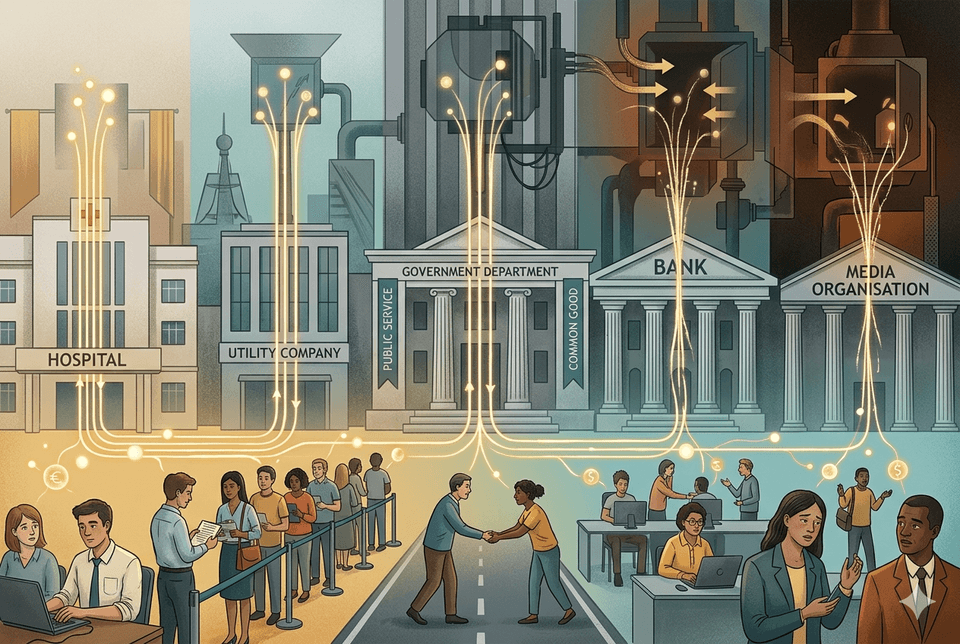
The institution — the hospital, the utility company, the government department, the bank, the media organisation — enters into an implied contract with the public the moment it takes on a public function. Not because anyone negotiated the terms, but because the function itself implies them. A water company that holds monopoly access to an essential resource has, by that very fact, accepted an obligation. Not merely to deliver water, but to deliver it in a manner that treats the dependency it has created as a responsibility rather than an opportunity. A media organisation that positions itself as the arbiter of public information has, by that positioning, accepted an obligation not to manufacture the reality it claims to report. A government that collects taxes under the argument that collective provision serves the common good has, by that argument, already agreed to something. The implied contract does not need to be signed. It is present in the claim. Every time an institution reaches for the language of public service, it is invoking the contract — whether it intends to honour it or not.
The interesting question is not whether the contract exists. It does. It has always existed, in every functioning society, as the silent scaffolding on which public trust is built and public life becomes possible. The interesting question is what happens when the institution inhabits the language of the contract while vacating its substance.
This is the mechanism I keep returning to, in this space and elsewhere. In the laundering essay I wrote about how war becomes the perfect disguise for extraction — how fear and scarcity and the spectacle of blood are used to hold the social contract at bay, to stretch it until it “no longer resembles consent but submission.” But war is only the most dramatic example of a pattern that operates in quieter registers every day. The energy company that holds prices at crisis levels long after the crisis has passed is not doing something categorically different from the warlord harvesting fear. It is doing the same thing with better optics. It is occupying the role of essential service provider — a role that carries an implied obligation of reasonable conduct — while stripping out the obligation and keeping the role. The form of the contract is preserved. The substance is not.
This is why the implied nature of the contract is not incidental. It is the mechanism of the violation. A written contract can be breached and challenged. It has clauses. It has remedies. It has a record of what was agreed and what was promised and what constitutes failure to deliver. The implied contract has none of these things. Because it was never written, its violation is never formal. Because it was never stated, it can never be technically breached. The institution that empties the contract of its content can always fall back on the same defence: point to where it says that. And you cannot point to it. Because it never said it. It only implied it, loudly and publicly and for as long as it needed the trust that the implication generates, and then it quietly stopped implying anything at all.
The asymmetry this creates is precise and devastating. The public, for their part, continue to perform. They pay their taxes and their bills and their fees. They comply with the authority of institutions they have been taught to regard as legitimate. They extend the trust that functional society requires and that no individual person can withhold without incurring a social cost. They hold up their side of a contract they were never asked to sign, because the contract is implied and implication does not require asking. Meanwhile, the institution has already repositioned. It has rotated from service to extraction, from obligation to opportunity. But it has done so without announcement, without revision, without the notification that any formal contract would require. The old language remains. The public service branding is intact. The websites still read like civic institutions. The mission statements still invoke the common good. Only the conduct has changed. And because the contract was never written, the change in conduct is not, technically, a breach of anything.
There is another layer to this that I think matters as much as the institutional dimension, and that is the human dimension. The implied contract does not only run between the citizen and the institution. It runs between all of us who live inside the same social reality, who share the same essential infrastructure, who are — whether we acknowledge it or not — dependent on one another in ways that predate and outlast any formal arrangement. The contract at this level is about what we owe each other simply by virtue of coexistence. Not charity. Not generosity. The more basic and more binding thing: the obligation not to use another person’s dependency as a lever. Not to turn necessity into a mechanism for your own enrichment. Not to treat the fact that someone cannot easily refuse your service as an invitation to extract whatever the market will bear.
When that implied obligation is violated — and it is violated, structurally and systematically, every time a monopoly provider sets price at the ceiling of what desperation will accept — the violation is experienced as something more than a bad business deal. It is experienced as a betrayal. And it is a betrayal. Not of a written clause but of the assumption of basic reciprocity that makes shared life possible. The assumption that the person or institution in the position of service is, in fact, oriented toward your wellbeing and not your capture. The assumption, in other words, that the word service still means what the word means.
What keeps this system running — what keeps people paying and complying and deferring long past the point at which the contract is clearly no longer being honoured on the other side — is a combination of mechanisms I have written about in other contexts. Fear is one. When the essential nature of the service means that refusal incurs a cost you cannot afford, participation is not consent. It is the performance of consent under conditions that make genuine refusal impossible. Complexity is another. The system that governs your energy bill, your healthcare, your housing, your financial products is not complex because the underlying problems are inherently intractable. It is complex because opacity serves a function. The person who cannot read the system cannot hold the system accountable. And shame — perhaps most insidious of all — shame disciplines the people who might otherwise articulate the betrayal. To name the violation of the implied contract is to be accused of ingratitude, of unrealism, of a failure to understand that the world does not owe you anything. As though the world were not the entity making the claim. As though the institution were not the one who reached for the language of obligation in the first place.
What I want to argue — what I think is both true and underarticulated — is that the implied social contract is not a soft or merely sentimental thing. It is the actual load-bearing structure of any society that does not wish to govern exclusively through force. Force is expensive. Force requires constant vigilance and constant application. The implied contract is far more efficient: it produces compliance willingly, continuously, at almost no cost to the authority that benefits from it, because the people who are complying believe, or half-believe, or once believed, that the terms are roughly fair. Destroy that belief and you do not immediately get revolution. You get something more insidious: a population that continues to perform compliance because they cannot see an alternative, while the trust that made the compliance meaningful drains away slowly and invisibly, until the day it is entirely gone and nobody can quite say when it left.
This is not a theoretical risk. It is a description of a process that is already well advanced in most Western democracies. The gap between the language of public service and the reality of institutional conduct has grown to the point where even the institutions do not bother to close it anymore — they simply invest in louder, more sophisticated versions of the language. The mission statement becomes more elevated as the mission becomes more compromised. The branding becomes more civic as the behaviour becomes more extractive. The implied contract is invoked more loudly and honoured more rarely, and the people who point this out are told they are being cynical, which has become a synonym, in the vocabulary of power, for accurate.
To name the implied social contract is not to idealise some vanished world of perfect institutions and selfless governance. It is to insist on the relevance of an expectation that every person who lives inside a society has already formed and carries and acts on every day. The expectation that the structures which claim your compliance and your taxes and your deference are, in return, oriented toward your welfare. That claim and its reciprocal obligation are inseparable. You cannot reach for the authority that the contract grants and decline the responsibility it entails. You cannot be a public service and treat the public as a resource.
That is not cynicism. That is the contract. The one nobody signed, the one that governs everything, the one that is broken not with a single dramatic act but with a thousand incremental retreats from the basic orientation that the word service was always supposed to imply.
The question that follows — what you do when the contract is broken but the system that broke it still claims its authority — is the question that none of the comfortable frameworks want to answer. And it is the one that keeps pressing.