

The World Beyond Our Models
An essay on why contemplation matters in an age of metrics—how models, measurements, and proxies shape what we believe, and why humility, calibration, and discernment are prerequisites for progress.
Page 1 of 2 | Posts 1-10 of 14 posts
Posts tagged "Epistemology".
An essay on why contemplation matters in an age of metrics—how models, measurements, and proxies shape what we believe, and why humility, calibration, and discernment are prerequisites for progress.

An exploration of how perception renders pocket realities, why the universe arrives in layers, and what “parallel worlds” can mean—from quantum branches to the worlds we carry inside our minds.

A reflection on how human experience—memory, agency, language, and narrative—shapes the frameworks we build, and what that means for time, causality, and the limits of physics as a “mirror” of reality.

A reflection on the finite life of the knower against the seemingly unbounded horizon of knowledge, and on what it means to keep learning and speaking in the face of that tension.

Measurement is never perfect. This essay explores how systematic and random errors shape what we can know, why replication and calibration matter, and how humility restores meaning to precision.

Perception is not raw reality but a construction shaped by biology, memory, and belief. From the science of color to the mysteries of synesthesia, this essay explores how our worldview frames what we see, hear, and know.

Before physics was an equation, it was a question. This essay traces its roots—from myth and wonder to natural philosophy—as humanity’s first attempt to read the book of nature.

Beneath every grand theory lies a quiet lattice of first principles and lemmas. This essay explores the bedrock and bridges of reasoning—and why inhabiting a school’s foundations matters more than memorising its slogans.

We build our worlds on belief—often reinforced by the echo of others—until illusion collapses and demands the harder work of integrity, repair, and renewal. This essay traces the arc from chorus to shattering to redemption.
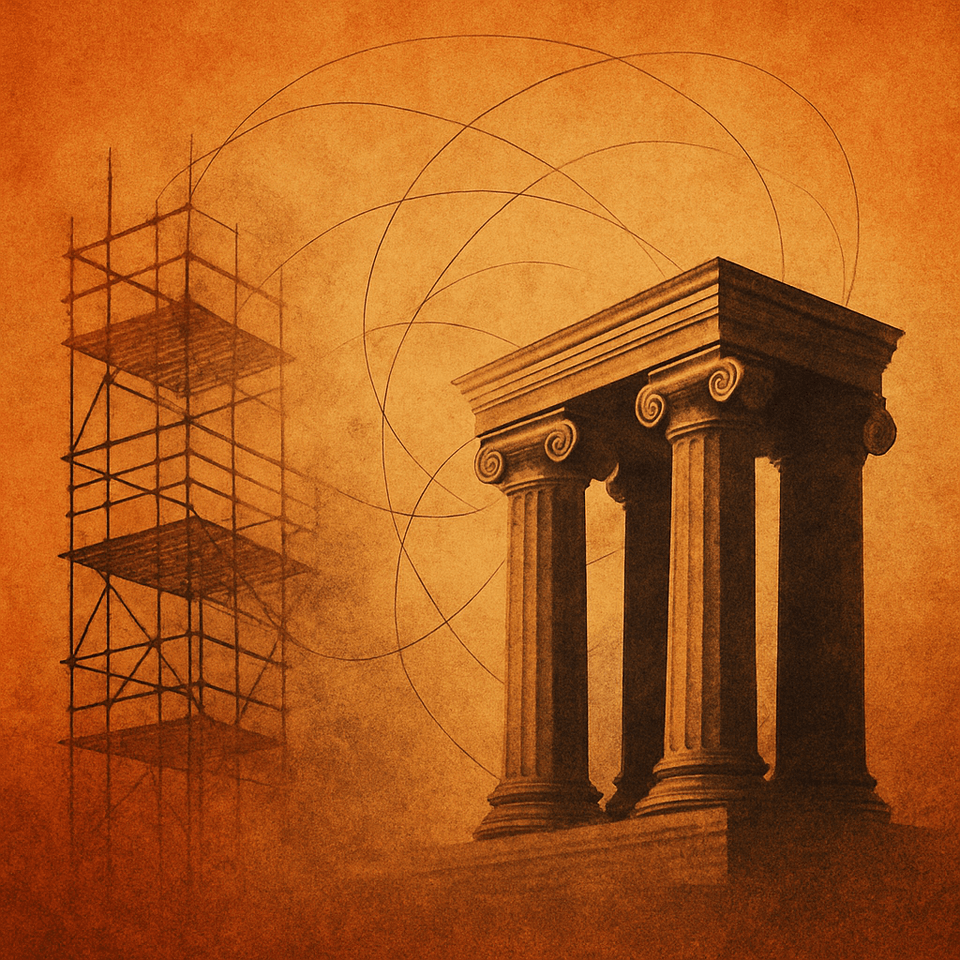
We trust science, law, and society for their apparent rigour — but beneath the surface lie hidden assumptions and convenient fictions mistaken for certainty. This essay explores how social apriories shape our systems of knowledge, from physics and medicine to the courtroom, revealing that what feels like stone is often only scaffolding. The task is not to discard these illusions, but to see through them with humility and discernment.
