
Tag: Market Structure

Page 1 | 9 posts

Posts tagged "Market Structure".

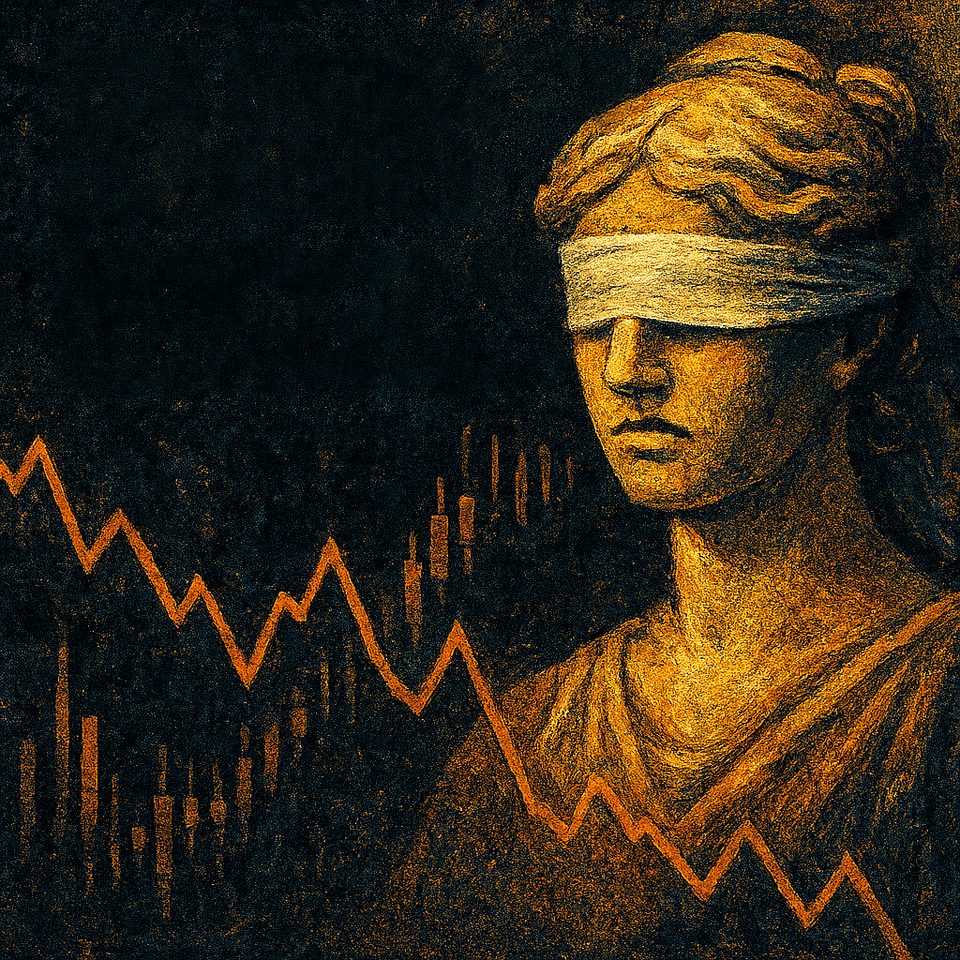
Cover artwork (cover.png) for the article titled The Market's Blindfold: Understanding Dark Pools, Hidden Venues, and Information Asymmetry.

The Market’s Blindfold: Understanding Dark Pools, Hidden Venues, and Information Asymmetry

The Understanding Market Mechanics series closes with the blindfold — the final veil that hides as much as it reveals. Markets are not neutral or transparent, but choreographed theatres of asymmetry where most begin at a disadvantage by design. This is not a guide to profit, but an invitation to awareness, humility, and the imagining of something fairer than the game we have inherited.

15m
Cover artwork (cover.png) for the article titled The Script and the Rhythm: Understanding Wyckoff Mechanics and Elliott Waves.

The Script and the Rhythm: Understanding Wyckoff Mechanics and Elliott Waves

In markets, cycles are not random—they are patterned expansions and contractions shaped by accumulation, distribution, and the relentless hunt for liquidity. By weaving Wyckoff mechanics with Elliott Wave theory, we can begin to see markets not as chaos but as choreography: waves rising, breaking, and receding with purpose. Yet volume is the compass, and in unregulated arenas like crypto, where wash trading distorts the signal, discernment becomes survival.

10m
Cover artwork (cover.png) for the article titled The Depths of the Market: Understanding Liquidity and the Order Book.

The Depths of the Market: Understanding Liquidity and the Order Book

In this third entry of the Understanding Market Mechanics series, we move beneath the surface of charts and candles into the bloodstream of the market itself: liquidity. From stop runs and iceberg orders to liquidity pockets, fair value gaps, price discovery, and reversion to the mean, this post explores how liquidity shapes every move. The market is not random—it is choreographed. Learn to read the current, and price stops looking like noise and starts speaking as a language.

10m
Cover artwork (cover.png) for the article titled The Invisible Balance: Understanding Pareto Efficiency, Markets, and the Zero-Sum Game.

The Invisible Balance: Understanding Pareto Efficiency, Markets, and the Zero-Sum Game

In markets, the 80/20 rule is more than a cliché—it’s the operating system. Pareto efficiency ensures that once an edge becomes visible, it disappears. The zero-sum nature of trading means every gain is another’s loss. To survive, it’s not enough to know the truth—you must anticipate what others will believe next, and act before they do.

9m
'Dark blue minimalist graphic with bold white text reading "Are You Trading, Or Is The Market' 'Trading You?" — designed to provoke reflection on market dynamics and psychological influence.'

The Philosophy of Markets: Money, Truth, and the Future of Finance

Sayed Hamid Fatimi's "The Philosophy of Markets" challenges conventional views on trading, suggesting that markets are not neutral but adversarial systems that exploit predictability and emotions. The book emphasizes the importance of understanding market structure, belief, and behavior over traditional analytical methods. It also discusses emerging financial alternatives like crypto and decentralized systems, proposing a shift toward a post-institutional world.

© 2025 Valeon. All rights reserved.