
The Human in the Equation
A reflection on how human experience—memory, agency, language, and narrative—shapes the frameworks we build, and what that means for time, causality, and the limits of physics as a “mirror” of reality.
Page 1 | 6 posts
Posts tagged "Physics".
A reflection on how human experience—memory, agency, language, and narrative—shapes the frameworks we build, and what that means for time, causality, and the limits of physics as a “mirror” of reality.
An essay on why symmetry comforts the mind, how science and mathematics chase invariance, and why asymmetry—through breaking, chirality, primes, and time’s arrow—is the texture that makes life and meaning possible.
Newton’s three laws as axioms, F=ma as the grammar of change, and how energy and momentum conservation emerge—told with minimal calculus and hands-on experiments.
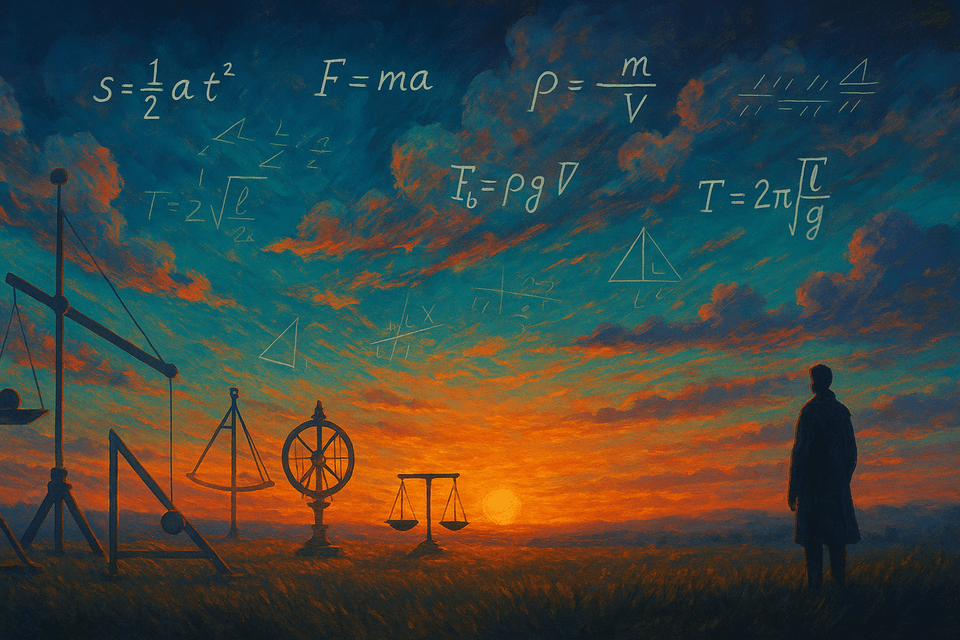
Physics turns wonder into practice: from Archimedes’ geometry and instruments to Galileo’s timing and idealisations, nature begins to speak in numbers we can test.
Before physics was an equation, it was a question. This essay traces its roots—from myth and wonder to natural philosophy—as humanity’s first attempt to read the book of nature.
Why does our universe exist in matter, when physics tells us it should have been born in perfect balance with antimatter? From CPT symmetry to Feynman’s vision of particles moving backward in time, from Penrose’s maps of spacetime to Hawking’s idea of imaginary time, the mystery deepens. This essay explores a radical possibility: that antimatter was never lost, but displaced into a shadow universe, unfolding along a different rhythm of time. Could this hidden twin still whisper across the folds of spacetime — perhaps even reaching from tomorrow into today?
